For Research Purposes Only — 99%+ Purity Guaranteed — USA Sourced
99%+ Purity
USA Made
Fast Ship

Hexarelin

Hexarelin is a synthetic hexapeptide growth hormone secretagogue and ghrelin receptor (GHS-R1a) agonist used in experimental models to study somatotropic and cardiovascular peptide signaling. In preclinical research, Hexarelin activates Gq/PLC-dependent calcium signaling pathways involved in growth hormone release while also engaging cardioprotective and metabolic mechanisms independent of GH secretion. Experimental studies have investigated its role in myocardial protection during ischemic stress, skeletal muscle preservation, and lipid metabolism regulation through peptide-mediated endocrine and paracrine signaling pathways. Hexarelin is utilized as a research tool in studies of cardiac peptide pharmacology, muscle metabolism, and ghrelin receptor biology.

For research use only. Not for human consumption.

References:
Camanni F et al., J Endocrinol Invest, 1998 21(9):646–654
Broglio F et al., J Clin Endocrinol Metab, 1999 84(9):3276–3280
Ghigo E et al., Eur J Endocrinol, 2001 145(1):1–10

$45.00

For Research Use Only

This product is intended for laboratory research purposes only. Not for human consumption, veterinary, or medical use.

Description
Overview

Hexarelin (also referenced in the literature as Examorelin) is a synthetic ghrelin analogue structurally related to growth hormone secretagogue peptides (GHS peptides). In research settings, hexarelin is used as a laboratory tool compound to investigate receptor selectivity and downstream signaling associated with the growth hormone secretagogue receptor (GHSR) and other binding partners reported in preclinical models.

Preclinical and cellular studies have applied hexarelin in experimental paradigms focused on stress-response signaling, intracellular ion handling, oxidative stress markers, and survival-associated pathway readouts in defined model systems.


Biochemical Characteristics

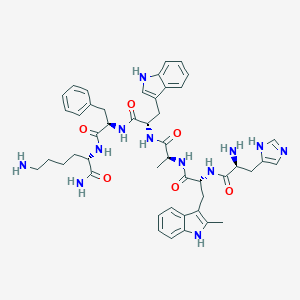
Hexarelin Structure

Source: PubChem

Sequence: His-D-Trp(2-Me)-Ala-Trp-D-Phe-Lys
Molecular Formula: C47H58N12O6
Molecular Weight: 887.059 g/mol
PubChem CID: 6918297
CAS Number: 140703-51-1

Research Applications
  • Receptor pharmacology studies involving GHSR signaling and ligand–receptor selectivity
  • Cellular stress-response experiments assessing survival-associated pathway readouts under defined conditions (e.g., nutrient deprivation or oxidative challenge models)
  • Mechanistic studies of intracellular calcium dynamics and excitation–contraction coupling markers in cardiomyocyte model systems
  • Preclinical investigation of fibrosis-associated molecular endpoints and remodeling-associated signaling in animal models
  • Metabolic pathway studies evaluating lipid and insulin-resistance endpoints in defined preclinical models
  • Skeletal muscle model research assessing mitochondrial integrity and calcium homeostasis markers in cachexia-associated paradigms
Pathway / Mechanistic Context

Hexarelin is commonly used to probe signaling networks downstream of the growth hormone secretagogue receptor (GHSR) in cellular and animal studies. Depending on the model system, reported mechanistic investigations include modulation of stress-response pathways, intracellular calcium handling, inflammatory mediators, and oxidative stress markers. Separate lines of research have evaluated interactions with CD36-associated signaling in cardiac model contexts, supporting broader mechanistic exploration of receptor cross-talk and pathway convergence in defined experimental settings[1], [3].

In cardiomyocyte-focused paradigms, hexarelin has been studied in relation to apoptosis-associated markers and remodeling-related signaling cascades, including PTEN-linked pathway nodes and downstream survival signaling readouts in animal models[3], [8].

Pathway / Mechanistic Context

Hexarelin is commonly used to probe signaling networks downstream of the growth hormone secretagogue receptor (GHSR) in cellular and animal studies. Depending on the model system, reported mechanistic investigations include modulation of stress-response pathways, intracellular calcium handling, inflammatory mediators, and oxidative stress markers. Separate lines of research have evaluated interactions with CD36-associated signaling in cardiac model contexts, supporting broader mechanistic exploration of receptor cross-talk and pathway convergence in defined experimental settings[1], [3].

In cardiomyocyte-focused paradigms, hexarelin has been studied in relation to apoptosis-associated markers and remodeling-related signaling cascades, including PTEN-linked pathway nodes and downstream survival signaling readouts in animal models[3], [8].

Preclinical Research Summary

Cardiac Model Systems (Cell Survival, Remodeling Markers, and Functional Readouts)

Rodent studies and cardiomyocyte model experiments have evaluated hexarelin in ischemia/reperfusion paradigms and related stress models, measuring apoptosis-associated markers, oxidative stress endpoints, inflammatory mediators, and function-related readouts within controlled experimental designs[1], [2], [4], [5], [8].

Preclinical myocardial injury model readouts comparing experimental groups.

Preclinical myocardial injury model readouts comparing experimental groups.
Source: PubMed

Additional animal-model work has examined myocardial fibrosis-associated endpoints and remodeling-associated molecular markers in infarction and hypertension-associated paradigms[4], [5]. Studies have also investigated intracellular calcium regulation in in vitro ischemia/reperfusion models as a candidate mechanistic contributor to observed pathway readouts in cardiomyocytes[7], [8].

Mechanistic schematic illustrating pathway nodes evaluated in preclinical myocardial injury models.

Mechanistic schematic illustrating pathway nodes evaluated in preclinical myocardial injury models.
Source: PubMed

Metabolic Model Context (Lipid and Insulin-Resistance Endpoints)

In defined preclinical metabolic models, investigators have reported lipid-related measurements and insulin-resistance endpoints following hexarelin exposure, supporting continued mechanistic study of ghrelin-analogue signaling in metabolic pathway research[9].

Skeletal Muscle and Cachexia-Associated Model Systems

Growth hormone secretagogue peptides, including hexarelin, have been studied in rat cachexia-associated paradigms to evaluate mitochondrial integrity markers, skeletal muscle calcium homeostasis, and related molecular endpoints under chemotherapy-associated stress conditions[10], [11].

Preclinical skeletal muscle molecular endpoint panels reported in cachexia-associated models.

A. Mitochondrial DNA content relative to control
B. Content of MCH1 and MHC2A mRNA
C. Protein content of muscle cells relative to control
Source: PubMed

Receptor Pharmacology and Ligand Development Context

Additional literature has described the development and characterization of ghrelin receptor ligands, including potency and selectivity assessments and endocrine/extraendocrine signaling observations in preclinical research contexts[12].

Form & Analytical Testing
  • Supplied as a research-grade peptide reagent intended for controlled laboratory workflows
  • Certificate of Analysis (COA), HPLC, and MS documentation provided below as supplied for this product lot
  • Identity and composition supported by analytical characterization (methodology may vary by lot)
  • Not manufactured or labeled for diagnostic, therapeutic, clinical, or veterinary applications

Referenced Citations

1

J. Huang, Y. Li, J. Zhang, Y. Liu, and Q. Lu, “The Growth Hormone Secretagogue Hexarelin Protects Rat Cardiomyocytes From in vivo Ischemia/Reperfusion Injury Through Interleukin-1 Signaling Pathway,” Int. Heart. J., vol. 58, no. 2, pp. 257–263, Apr. 2017. [PubMed]

2

Y. Mao et al., “Hexarelin treatment in male ghrelin knockout mice after myocardial infarction,” Endocrinology, vol. 154, no. 10, pp. 3847–3854, Oct. 2013. [PubMed]

3

E. Agbo et al., “Modulation of PTEN by hexarelin attenuates coronary artery ligation-induced heart failure in rats,” Turk. J. Med. Sci., vol. 49, no. 3, May 2019. [PubMed]

4

H. McDonald et al., “Hexarelin treatment preserves myocardial function and reduces cardiac fibrosis in a mouse model of acute myocardial infarction,” Physiol. Rep., vol. 6, no. 9, p. e13699, 2018. [PubMed]

5

X. Xu et al., “Chronic administration of hexarelin attenuates cardiac fibrosis in the spontaneously hypertensive rat,” Am. J. Physiol. Heart Circ. Physiol., vol. 303, no. 6, pp. H703-711, Sep. 2012. [PubMed]

6

X. Zhang, L. Qu, L. Chen, and C. Chen, “Improvement of cardiomyocyte function by in vivo hexarelin treatment in streptozotocin-induced diabetic rats,” Physiol. Rep., vol. 6, no. 4, 2018. [PubMed]

7

Y. Mao, T. Tokudome, I. Kishimoto, K. Otani, M. Miyazato, and K. Kangawa, “One dose of oral hexarelin protects chronic cardiac function after myocardial infarction,” Peptides, vol. 56, pp. 156–162, Jun. 2014. [PubMed]

8

Y. Ma, L. Zhang, J. N. Edwards, B. S. Launikonis, and C. Chen, “Growth hormone secretagogues protect mouse cardiomyocytes from in vitro ischemia/reperfusion injury through regulation of intracellular calcium,” PloS One, vol. 7, no. 4, p. e35265, 2012. [PloS One]

9

R. Mosa et al., “Hexarelin, a Growth Hormone Secretagogue, Improves Lipid Metabolic Aberrations in Nonobese Insulin-Resistant Male MKR Mice,” Endocrinology, vol. 158, no. 10, pp. 3174–3187, 01 2017. [PubMed]

10

G. Sirago et al., “Growth hormone secretagogues hexarelin and JMV2894 protect skeletal muscle from mitochondrial damages in a rat model of cisplatin-induced cachexia,” Sci. Rep., vol. 7, Oct. 2017. [nature.com]

11

E. Conte et al., “Growth hormone secretagogues prevent dysregulation of skeletal muscle calcium homeostasis in a rat model of cisplatin-induced cachexia,” J. Cachexia Sarcopenia Muscle, vol. 8, no. 3, pp. 386–404, Jun. 2017. [PubMed]

12

Torsello, Antonio & Bresciani, Elena & Tamiazzo, Laura & Bulgarelli, Ilaria & Caporali, Simona & Moulin, Aline & Fehrentz, Jean-Alain & Martinez, Jean & Perissoud, Daniel & Locatelli, Vittorio. (2008). Novel potent and selective non-peptide ligands of ghrelin receptor: characterization of endocrine and extraendocrine actions. [ResearchGate]

ALL ARTICLES AND PRODUCT INFORMATION PROVIDED ON THIS WEBSITE ARE FOR INFORMATIONAL AND EDUCATIONAL PURPOSES ONLY.
The products offered on this website are furnished for in-vitro studies only. In-vitro studies (Latin: in glass) are performed outside of the body. These products are not medicines or drugs and have not been approved by the FDA to prevent, treat or cure any medical condition, ailment or disease. Bodily introduction of any kind into humans or animals is strictly forbidden by law.
Product Index ×

Peptide Blends

GHRP-6
Hexarelin
Ipamorelin

Purchase Peptides

AOD 9604 5mg
BPC-157 10mg
BPC-157 5mg
DSIP 5mg
GHK-Cu 100mg
GHK-Cu 50mg
GHRP-2 10mg
MOTS-c
NAD+ 100mg
NAD+ 750mg
PT-141 10mg
Selank 10mg
Semax 30 mg
Product Index ×

Cognitive

DSIP 5mg
Selank 10mg
Semax 30 mg

Energy

MOTS-c
NAD+ 100mg
NAD+ 750mg

Muscle Healing & Tissue

BPC-157 10mg
BPC-157 5mg

Sexual

PT-141 10mg

Skin

GHK-Cu 100mg
GHK-Cu 50mg
×

Notify Me

We will email you when this item is back in stock.

Hexarelin
$45.00